Milton (Part One)
Everything we did, found, and didn't find on my trip to Alabama

(If you’re reading this story in your email, click “View entire message” at the bottom of the story, or read it on Substack.)
When I step out of the airport in Birmingham, the only prisoner in my book about Bullock Prison to have made it out since the book’s publication is there to pick me up. His is the first face I see here (aside from the woman on the plane who advocated to the stewardess that I get a seat with more leg room, then showed me how to exit the airport, which was so small that I was embarrassed to ask for help).
J-Ray picks me up and takes me to the halfway house where he’s been staying for veterans getting out of prison, and shows me around. He lives and works there now. After a stop at his favorite barbecue spot, he drives me to the house of a large family I’ll be staying with while I’m here researching.
The family of Milton Jones is spread out between Birmingham and Livingston. I start at his cousin’s house in Birmingham, where we will all gather for the annual Fourth of July family reunion in a couple of days. For research purposes, we decided it would be best for me to be there when the whole family is all there at the same time, but I’ve also been told I’m part of the family now, so I’m here now for that reason too.
There’s another reason that it’s important for me to be here while everyone else is here, but we won’t know it until the Fourth of July arrives.
This is the house of Milton’s cousin. She is 41. She was born after Milton was in prison, wasn’t told about him growing up, and built a relationship with him over the phone in her adult life.
In the house are the cousin’s three sons and one of their sons, her grandson. The cousin’s mother, one of many aunties of Milton, lives down the street from her.
I discover quickly that writing about this family is a bit like reading a Russian novel. There are many characters, related to each other in all sorts of ways, and everybody has more than one name.
The first night, I don’t turn my recorder on. I just listen.
I’ve been working on Milton’s story and trying to get him out of prison for seven years, and have been in touch with his family for the last couple of years, after years of trying to track them down with no success. We’ve never met in person before, and I’ve never met these kids at all.
Better to just use this time to get to know each other. The oldest son and his mom are awake. So is the little man, the oldest boy’s son, Milton’s cousin’s grandson. He says he is three years old. His grandmother says he is four. He’s watching TV late. He is “a night owl” who “takes after his daddy,” his grandma tells me.
Eventually, I’ll fall asleep on the couch and wake up and see the little boy is half asleep on the floor in front of the TV, cocooned in a little blanket that he might carry everywhere around the house after a certain hour at night.
His great-grandmother, who lives down the street, calls him “Stank,” but in a cute, playful, affectionate way.
Within minutes of arriving at this house, I’m already beginning to regret not turning my recorder on. The oldest son and his mom start telling me story after story. I don’t even have to ask questions. They both want to catch up with each other and catch me up on who went to prison, who got out, who got shot and who shot someone, who got killed and who did the killing, who got arrested but who actually did it, who is innocent, who is guilty, who got what time, who made some money, who lost some money, how much was made or lost. Almost all of the stories are about relatively recent events. Every two minutes, another story.
The son tells me a story about a guy in the projects working with dudes from Chicago. The guy’s job was to trade crack rocks for Social Security numbers and send them to the people in Chicago “who have been typing everything on these computers.”
The oldest son says he is pretty sure he saw his grandfather, his mom’s dad, trading his Social Security number for a rock. They both start laughing. She turns to me and says, “Yeah, that’s my daddy. He’ll talk your ear off. He got some stories. He’ll probably ask you for money though.”
Crack cocaine, both its use and its criminalization, has long disproportionately affected the black community in cities like Birmingham and played a role in fueling mass incarceration.
The oldest son goes in and out of the room periodically. When he’s in the other room, his mom continues talking in a steady, quiet voice, as if she’s not saying anything important.
Story after story, loss and tragedy after loss and tragedy, with plenty of funny stories mixed in.
The TV is on 24 hours a day, and the lights, for the most part, stay off 24 hours a day. The talk is low and the TV is loud, so you have to be good at listening.
When her son steps out of the room for a minute, she tells me with zero change of tone, and still staring straight ahead, that she wonders if her son will tell me about the time he got shot. She tells me a little about it herself. All she really knows is that he was walking to the store, that he turned down fentanyl for the pain when he got to the hospital because the streets have made him afraid of it, and that he didn’t tell her when he got shot. “He told me they were draining mucus from him because he say I ‘over exaggerate,’” she explains. It’s not clear how she eventually found out.
He had stepped out to go to the store to get a Black & Mild before she told me this story, you see. She is now afraid every time he goes to the store for a Black & Mild, especially at night. That’s what made her think of it and tell me the story, nothing I said or asked.
When he gets back, I ask him if he’ll tell me about the time he got shot. He’s an interesting kid, smart and well spoken, sweet but tough. He’s skinny. He doesn’t look like the oldest. He sounds like the oldest though. He leans back with his eyes half closed and scratches his chin while he’s talking, despite the lack of facial hair. He’s like a 45 year old in a 23 year old’s body. He tells me his story is nothing crazy compared to those of other people he knows. I tell him that nonetheless it sounds like he’s been through a lot.
Birmingham has long suffered from gun violence, and experienced its highest year of lives lost to gun violence in the city’s history in 2024.
He says he was walking to the store with his friends when a group of five other kids drove by and “put the beam on” him. They pointed their guns at him and his friends and a shootout ensued. He was shot in the rib cage and went to the hospital. He confirms that he had told his mother he had a mucus infection because “she over exaggerate” and he “didn’t want her to panic and worry.”
His mother, listening on, timidly says, “Yeah, but you’re supposed to tell your mama when something like that happens.”
There’s a pause. “I agree with your mama, bro,” I add. I tell him I’d be calling my mama screaming if I got shot.
He nods like he understands this but doesn’t say anything. Next time he leaves the room, his mother tells me another story about him.
They were in a grocery store one day and a woman standing nearby dropped money on the ground, so she had an important moral decision to make here in front of her son. She made the wrong one. She decided to stand on the money so that the woman who dropped it wouldn’t see, picked it up after the woman walked away, then she gave the money to her son. Her son, however, instead of accepting the money, chased the woman down at the front of the grocery store, told her she had dropped it, and gave the money back. He told his mom it wouldn’t be right for them to take that woman’s money because “you don’t know what that lady be going through right now.”
She is not proud of her own choice in that moment, but she is proud of her son. “That’s when I knew I raised him right,” she says.
Eventually, it’s time for her to go to sleep. Stank falls asleep on the floor in front of the TV that’s always on but no one is ever watching. The next morning, he is awake before anyone else.
When I first arrived, he wouldn’t talk to me for the first half hour or so. I’d ask him a question and he’d look up at me with a blank stare. He doesn’t like trying to answer questions he doesn’t know the answer to, I learn quickly, like, “How old are you,” or, “What you watching?” And speech is a challenge for him. But he likes when people talk to him.
The night I arrive, he is wearing a green tank top that reads “WILD CHILD,” and wears the same outfit the next day. I don’t change my clothes the next day either.
Stank is the last one asleep at night and the first one awake in the morning, and now he won’t stop talking. He wants me to hang out with him all day. Everybody more or less lets him do his thing (though he’s often not sure what to do) but they make the sweetest, most endearing, loving threats and disparaging comments. It’s hard to explain this. When you just read the words, they sound mean, but when you hear them, they sound loving and sweet and endearing. His great grandmother, every time he whizzes by as she’s cooking, says something like, “What you doin Stank, with your bad self?” Or my personal favorite, “You need to sit down, Stank. You play too much.” Then he goes on playing and nobody stops him.
When he leaves the back door open, running in and out of the house while she’s trying to barbecue, she says, “I’m a knock you out you don’t close that door, Stank, letting them flies in here.”
Stank quickly picks up on the fact that I’m the only one in the house who can’t say no to him. And then he won’t let me write. Late morning, I’m writing at the dining room table. He runs up and asks, “What you doin?”
“I’m writing,” I answer.
He looks at me confused.
“I’m a writer,” I explain.
“I wanna do that,” he says, grabbing my notebook.
“You want to be a writer?” I ask.
“Yeah,” he answers.
His great grandmother, Milton’s aunt, working in the kitchen, chimes in. “I wish you would. It’s good money.”
I quickly intervene and explain that it’s not good money and I don’t mean to give the wrong impression.
I stop writing and cede control of the notebook. I just tell him to make sure not to draw on any of the pages that have words on them. There are a couple of close calls but he doesn’t. He does, however, draw on nearly every single blank page in the notebook, so I have to write this story over his drawings from here on out.
After this, he wants to play games. These are all games he has made up. He likes me to go in the corner with my back turned while he draws a picture in my notebook, then he crawls under the kitchen table and tells me when to turn around. He seems amused by the double surprise of revealing whatever he was drawing and having me discover that he’s hiding simultaneously. He likes to walk up behind me and tap my shoulder, then duck and laugh while I pretend I don’t know where he is, asking all the adults around if anyone has seen Stank. He likes to play catch with the basketball. He likes me to roll the basketball to him so that he can kick it as hard as he can. He likes when I watch and shake my head in disapproval as he sneaks water bottles into an empty cooler with no ice in it after the other adults have told him not to, once they’re not looking. At one point, he’s playing a game in the kitchen where he takes my pencil, pretending he wants to draw, then throws it at me, so I take the pencil back. He kicks me in the nuts pretty hard. He thinks it’s funny. I don’t snitch on him.
Later that night, the night before the Fourth of July, I’m in the living room alone. The three sons of Milton’s cousin are all in their rooms. It’s getting late. At one point, the oldest child and middle child come out to the living room. I ask them if I can talk to them for a moment. They sit down.
I didn’t interact with the middle sibling much before this. I’d seen him in the kitchen earlier and introduced myself and asked him if he knew who I was and if it had been explained to him what I’m doing there. He has a kind face. He nodded politely but didn’t say anything else. I hadn’t seen the youngest much yet either. I’d talked the most with the oldest but hadn’t interviewed any of them yet.
When we sit down, I say this: “I know your mom talked to you a little bit about this, but I just want to explain to y’all what I’m doing here in your house and what I’m trying to accomplish here.”
I give them the backstory of how Milton ended up in prison and how long he’s been there, as best I understand it. It’s clear they haven’t heard many of these details before. Only the oldest has ever spoken to Milton, and he has only spoken to him once. They seem a little shocked by the details of the story, which is saying a lot for these kids.
After describing what I’ve learned about Milton’s case over the years, I continue something like this, being a little too longwinded: “So, look, I’m not trying to put myself on a pedestal and I don’t want anyone else to do that either. I have my own long complicated story of who I am and how I got into this, and I don’t know if I’ll ever get him out of prison. But I’m trying to tell Milton’s story, and a big part of his story is his family. Part of that is the family he has had this whole time. Some of them have tried to help him in one way or another over the years, and all of them have been missing him and feeling his absence. Another part of the story though is that they’ve kept him locked up so long that he’s got a lot of family he’s never met and doesn’t know. When I met Milton, your mom was one of only a couple of family members who were in touch with him, and your mom was born after he was already in prison. They’ve never met face to face. So, I guess what I’m saying is a big part of Milton’s story is his family, and a big part of his family’s story is living in Alabama. So, I’m trying to interview as much of the family as possible, not only the ones who know Milton, about life in Alabama, even if you’ve never met Milton.”
They think over what I’ve said for a moment, then the oldest one tells me he wants to do an interview. I interview him on the porch. He tells me about his life, how the imprisonment system in Alabama has impacted his community, his friends, and his family. He tells me again about the time he got shot, this time with the recorder rolling. He says he believes the biggest thing people in Alabama are struggling with is “the economy,” the prices of food, gas, and housing going up and up.
He tells me one of the biggest reasons he was apprehensive to be interviewed is that people from other parts of the country often can’t understand what people from his community are saying when they talk and ask them to repeat themselves all the time. I tell him if I can do it on the prison phones, I should be able to do it in person. And it turns out I can hear what he is saying just fine.
When we go back inside, the youngest brother, 15, comes out of his room. I tell him the same thing I told the other two. He is a nice kid. It’s late at night, but after I explain the situation, he says he wants to do an interview with me before I leave.
At one point, while we are discussing the situation, he apologizes for interrupting me and then asks me if I believe in God, and if I have ever had an experience where I talked to God or believed He was with me. I try to answer him, then I ask him the same question, if he believes in God or has ever had a conversation with Him or felt like He was with him.
“Yes, sir,” he answers. I ask him if he can tell me what it was.
About a year ago, he tells me, he was walking down the street in Birmingham when a group of other kids drove near and started shooting at him and his friends. He was 14 at the time. He was unarmed. I ask him if he knew the kids who were shooting at him. “No, sir,” he says.
He explains that somehow he didn’t get hit with any bullets. He felt something bigger than him, a divine force, protecting him. Since then, he has been talking to God more.
So, this mother’s oldest and youngest son have both been shot at by people they don’t know while walking down the street in Birmingham within roughly the past year, according to them.
The next day is the Fourth of July and most of the family is here altogether. Even on many non-holidays, there is often no breakfast in this house. Instead, Milton’s cousin and her mom, Milton’s aunt, Stank’s grandmother and great grandmother, wake up early and start barbecuing for lunch and dinner. They cook all morning on the Fourth.
The day is full of eating and dancing and laughing. I interview Milton’s uncle, who hasn’t spoken with Milton in decades, since soon after Milton went to prison. I interview him about his life, Milton’s life, and life in Alabama.
Later, another one of Milton’s first cousins arrives from Michigan with his girlfriend. He and I have grown close over the phone, but like the rest of the family, I’ve never met them in person. He hasn’t been back home in a long time, and reuniting this year around the cause for Milton feels beautiful for everyone. He is the most formally educated member of the family. Years ago, after I started working on Milton’s case but before I succeeded in tracking down his family, about two years after I would’ve started working on it, he helped his aunties send emails to Equal Justice Initiative and deal with some paperwork around the case. I originally got in touch with him because I wanted to see those emails and that paperwork, and the aunties directed me to him after I tracked them down.
He discovered his cousin Milton while trying to create a family tree. Nobody had told him about Milton. As of this July Fourth, he has never met or spoken to Milton, and like the other cousin here, was born after Milton was in prison.
The communication with Equal Justice Initiative years prior evidently fizzled out and went nowhere, and the family has had a hard time following up with them, both about why it didn’t go anywhere and in their attempts to try to get the trial transcript from Equal Justice Initiative more recently, if it exists, since the courthouse doesn’t have it.
This cousin was shocked I had discovered Milton’s case. We got along right away and he wanted to help, and he has been very helpful and become a dear friend in this process, more and more of a research assistant the longer we know each other, in addition to the friendship.
After the cookout, he and I and his girlfriend will drive down to Livingston, Alabama together, where Milton and his family are from and grew up, where we’ll track down leads and do research together, eating every meal together, driving everywhere together.
During the barbecue, Milton calls around 3:00 in the afternoon. The whole family is there. Many of them he has never met. Others he has not spoken to in decades. His aunt answers the phone. One of Milton’s cousins asks me if I should record this. I turn on my recorder briefly but then I turn it off. I decide this is their moment, not mine, and I want them to speak with him as freely and comfortably as possible. She tells everyone Milton is calling and the music stops. She speaks to him for a moment. She tells him everyone is here and asks him who he wants to talk to. He asks if I am there. She walks over to me, and as she is handing me the phone, says, “Yep he cryin.”
I take the phone. I can immediately hear that he is fighting back tears, that he doesn’t want me to hear that he’s crying. I’ve known Milton about seven years, and this has only started happening in the last year or so. I’d never heard him cry in the years prior.
His voice shaking, he asks me what we are eating today. Despite how much fun I’m having today, and how much I love this family, I am still here for work. This is my job. And I try to stay solid at work, for Milton and for all my sources. I don’t want to cry at work, and I don’t think he’s ever heard me cry. But, as soon as I try to answer his question, as soon as I start listing off all the foods we are eating, I start crying too, pretty hard. Thankfully, I have my back turned to the cookout and dark sunglasses on. “Ribs, chicken, collard greens, mac and cheese.” I’m choking on all these words as I push them out.
I talk to him briefly, then I see his cousin, the one living in Michigan who discovered him when working on the family tree, shooting me a quick glance. It feels like it’s time.
He has never spoken to Milton. Like other cousins and second cousins, he was born after Milton was in prison. Since we met, I’ve been encouraging him to get in touch with Milton. There is an element of guilt, an element of sadness, and a host of other emotional and psychological factors tied up with it that I can only imagine play into his hesitation.
Months back, he decided he was ready, but in a way, it was too late. This cousin would say it just wasn’t the right time. He has a more positive attitude than me when things don’t work out in life or in work, and is more trusting of the universe.
After my book about Bullock Prison was published in August 2025, and the HBO documentary The Alabama Solution came out a month later, the Alabama Department of Corrections changed its communication system over from Securus Technologies, a company that was evil and parasitic enough, to a company called IC Solutions, which is even worse.
By the time this cousin decides to reach out to Milton, under the new system, prisoners need to get every phone number they want to call on an approved calling list, which takes about six months per phone number. Everything now goes through poorly working, scam filled tablets that are distributed to the prisoners. And as of the last seven or eight months, prisoners are no longer able to receive paper mail.
Up until I wrote my book about Bullock, you could simply go into the ADOC inmate search, find the name and AIS number of the prisoner you want to contact, Google the address of the prison, and write any prisoner a letter. This is how I made contact with several of my sources in Bullock in order to write the book. I would not be able to write the book now the way I did then. I pride myself on being one of the only journalists willing to interview prisoners through traditional methods of communication, legal ones, rather than cell phones, because I want everyone to have a chance to talk to me, and most prisoners cannot afford contraband cell phones. But now the system is making traditional communication harder too.
IC Solutions has taken over the mail system, in addition to the phone system. So, if you want to write a letter to an Alabama prisoner, now you have to send it to an address in Texas where it gets scanned, uploaded to the prisoner’s tablet, then shredded.
So, by the time Milton’s cousin decides to write him a letter, he has to do it that way.
The problem is that Milton has trouble working his tablet, and has been having trouble reading, in no small part because he is partially blind now due to poorly treated diabetes. So, when his cousin finally writes him a letter, he doesn’t know how to find it on the tablet, and he wouldn’t be able to read it if he could, so he never got the letter.
To be clear, this new system means that Milton can no longer get mail in prison due to his disability. Reception of mail has been ruled on and determined to be a constitutionally protected right for prisoners. I’m not aware of a loophole exception for prisoners with disabilities that the ADOC and IC Solutions do not want to accommodate.
So, when his cousin shoots me that glance, I know it’s time. I know this is a big moment for both of them. I ask Milton if he wants to meet his cousin. Then I walk over to his cousin and hand him the phone. I see them talking and laughing from a distance. The phone goes to a couple other family members. Later, his cousin tells me they talked about how they don’t normally trust white people. He says Milton recalled how shocked he was when he found out I was white years back.
Milton talks to an uncle he hasn’t spoken with in decades. The uncle cries a little. At the end of the call, Milton is on speaker phone and we all tell him we love him and that we hope to do this all with him next year. I’m crying behind my sunglasses for a while after this, not saying anything.
Stank keeps coming up to me at the cookout and asking me to kick the basketball around with him. I want to buy him a soccer ball. I keep saying yes to him. It seems like no one else is playing with him today, and he doesn’t really know what to do with himself. Eventually, though, I need to eat. When he comes out again with the ball, Milton’s cousin looks up at me and says, “Matthew, you have to say no this time.” Everyone laughs. I can feel Stank walking up to me with the ball. “Don’t even look at him, Matthew. You’ve got to eat. Don’t even look at him,” says the cousin, everyone laughing, myself included. Stank pokes me on the shoulder. I tell him it’s too hot right now, that I need to sit down for a little while, and that I need to eat. He takes the news okay, a little disappointed but he knows instinctually that he is too outnumbered by too many adults for a meltdown to happen right now.
“If he keeps me playing outside in this heat much longer, y’all are going to be calling both of us ‘Stank,’” I joke to his grandmother, Milton’s cousin.
It has been a beautiful day, but now I’ve got to go to Livingston, the hometown of Milton and his family. Around 6:00, I am getting ready to leave with Milton’s cousin who came down from Michigan and his girlfriend, Milton’s cousin-in-law to be. I tell Milton’s other cousin, Stank’s grandmother, whose house we are at, that it’s time for me to go to Livingston and get more work done for Milton. I thank her for her hospitality. I hug everyone goodbye. Then it’s time to say goodbye to Stank. In the kitchen, I tell him I have to leave for a couple of days and then I’ll be back. He looks at the floor, takes a pause of sadness, then runs up to me and hugs me. I didn’t know yet that there would be too much to do in Livingston and I wouldn’t be able to make it back to Birmingham until the morning of my flight home.
Finally meeting Milton’s aunties at the cookout, his army of aunties, who have known and stuck by him as best they could throughout this life, is a profound experience.
Meeting the aunties, and the cousin whose house we are in who met Milton over the phone in her early adult life, was probably the most profound moment of the trip. It has been too long. Writers learn, sometimes the best way and sometimes the hard way, that there are some things in life for which there are no words. On July Fourth, I learned it the best way, all day long.
That night, we stay at the house of the mother of the cousin I am researching with, another one of Milton’s aunties, the only one still living in Livingston. I feel at home everywhere I go here.
The next morning, we interview a childhood friend of Milton’s named Tony Jemison. When we type in his address, the GPS sends us passed a trailer park in the middle of the woods and stops us at a blue factory building miles down a dirt road, clearly not Tony’s house. We call him. A combination of talking on the phone and him walking down the dirt roads waiving at us brings us together, and we follow him to his trailer.
Tony is listed as one of the only three witnesses for the defense in Milton’s court file. He showed up to the trial when subpoenaed but Milton’s public defender did not call him to testify, according to Tony. Without the trial transcript, I can’t be completely sure, but from what I can gather thus far from firsthand interviews and old articles that a local archivist helped us dig up from archives that aren’t online, nobody testified on Milton’s behalf, and Milton refused to speak because of death threats to him and his family. At least one of the three people listed as his witnesses is also a suspect, and after researching this case for years and spending time in Livingston, I can report that, among people in the black community in particular who recollect this crime, no one I’ve come across believes it was Milton who committed it. I’ve even met people who don’t remember Milton but vaguely remember the victim and the crime, and believe it was this other person, an older man, one of the witnesses listed for the defense, who didn’t testify and allegedly made death threats to Milton to intimidate Milton against testifying himself. At this stage, I will not include that person’s name. He is now in prison for a murder committed just a few blocks away from where the crime occurred that Milton is now in prison for, maybe a five to 10 minute walk.
I interview Tony about that day 44 years ago. He claims that Milton was with him that night, that they stayed with his family down the tracks, and that Milton did not commit the crime for which he is in prison. He tells me Milton was a shy kid, funny but shy, that he was afraid to talk to girls, and that it was hard to make him angry.
Tony got into trouble as a kid as well. The other two witnesses for Milton’s defense also had criminal records. It’s possible this is why they were not called to testify. Even if Milton’s lawyer sincerely wanted to help, he might have thought the prosecution would discredit these witnesses based on their records. In front of an all white jury, a white judge, and a white prosecutor, these are not all star witnesses.
Since the trial transcript is missing, there’s a great deal about which I can only speculate. But my theory as of this writing is this: Especially if there were indeed death threats, as Milton and his family have told me, Milton was afraid, and found himself with the worst possible defense in that courtroom, which goes something like this: I swear I didn’t do it, but I know who did it, but I can’t tell you. I believe that when Milton went to trial with this defense, the state decided to bring the hammer down on him and make an example of him. Indeed, in one of the old articles about the trial dug up by the archivist, after it was over, prosecutor Nathan Watkins openly admitted that he wanted to “make an example” of Milton.
After I interview Tony Jemison about Milton’s childhood and the details, or lack thereof, of the crime, we all get into Milton’s cousin’s car and Tony shows me and Milton’s cousin all around town.
He takes us to his childhood home, a trailer from which he used to walk on the train tracks to meet up with Milton.
He takes us to the graveyard where he, Milton, and a couple of much older men who purchased alcohol for them and smoked weed with them hung out in a small clearing in the corner of it. This is a white cemetery (more on that later in the series). On the other side of the woods from the graveyard are train tracks.
In one direction, just beyond a large stack of logs in the distance, is where the house Milton grew up in used to be.
Milton’s mother was, by Milton’s own account, a prostitute who had Milton when she was 15, the same age at which he would later go to prison at five foot seven and 120 pounds. At 15, when she had Milton, she was having a difficult time in her own life, and Milton never knew his father, so his mother gave him to a woman named Ms. Scrappy, who raised him and loved him.
Between Ms. Scrappy’s house and where we are standing, down a little embankment on the other side of the tracks, is where Milton’s aunties lived. These houses have all been destroyed now too and there is some type of industrial building there in their place, which does not look booming.
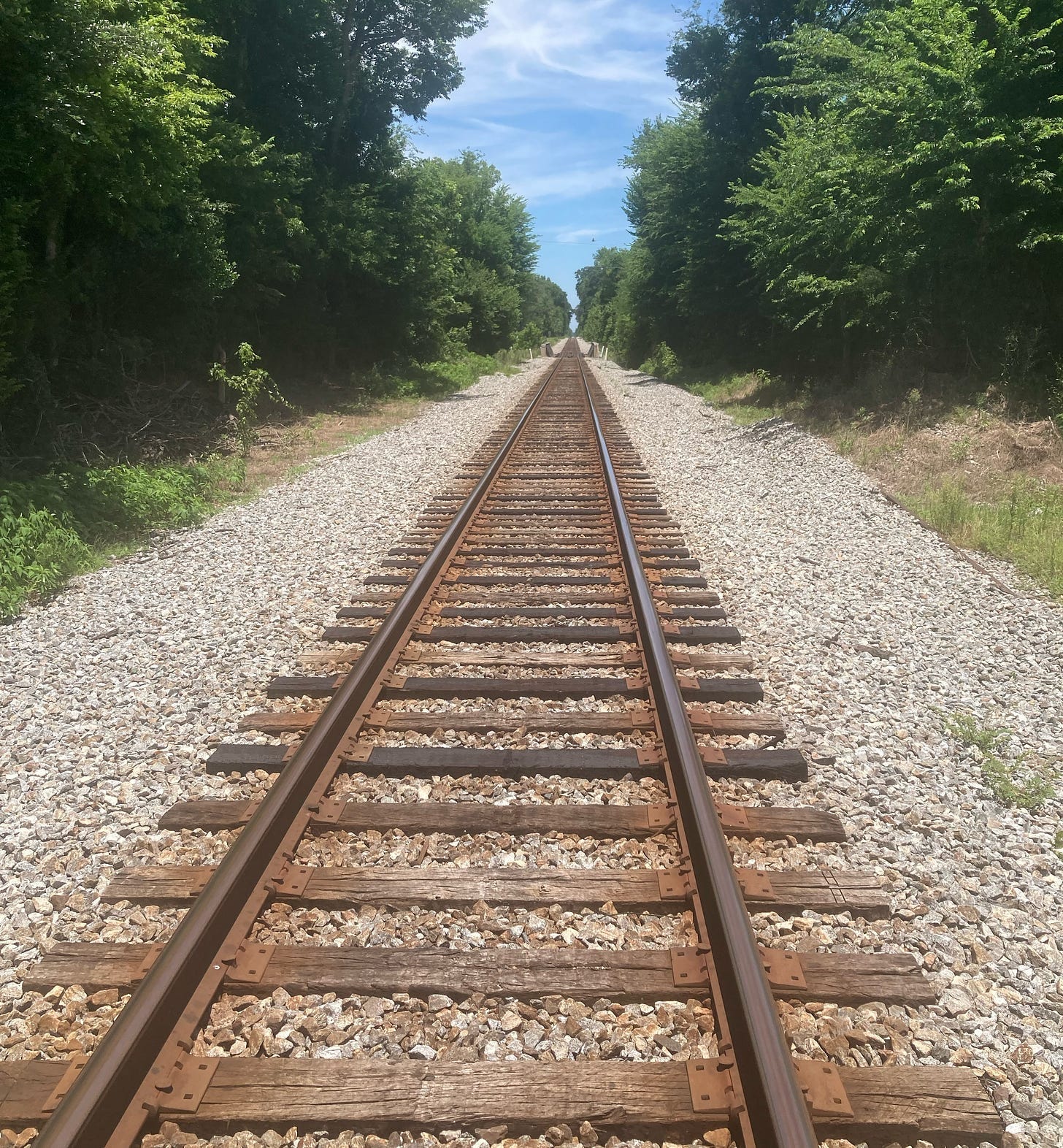
I’ve heard a lot about these train tracks over the years interviewing Milton and his family, and now Tony Jemison. Most of Milton’s aunties, some of whom were around Milton’s age or a couple years younger than him growing up, used to meet up with him by walking to each other on the train tracks. That’s how he and Tony hung out too. And they walked on the tracks to the graveyard, then back to the house where someone takes you in. Everywhere they went, with everyone they loved, everyone they needed to go to and every time they needed to get away from something, they were connected to each other through the tracks. The train tracks were an important part of some people’s lives in this community. I can’t help but notice many of the houses of those people and that community are demolished now, yet the victim’s house, and the whole white neighborhood it’s in, remain intact, more or less recognizable as the houses they were back then.
I turn the other direction down the tracks and I’m facing the direction of Mayme Peacock’s house, the victim of the crime for which Milton is in prison. If you’re taking the road, it’s just around the corner, and there’s a kind of path that runs behind it. Hers was the first house on the road to the right after you turn the corner. I note with interest that there is a small police barracks right across the street, which Tony tells me was there back then as well, in between the graveyard and the victim’s house. I take a picture of the house.
We continue down the road a couple more minutes, driving at a slow pace, maybe a seven minute walk or so, and Tony shows us the house in which the person he believes committed the crime for which Milton is in prison allegedly murdered a local university cafeteria worker, which is the crime that man is in prison for now.
All of those places are walking distance from each other, by road or tracks.
After this, we reflect with Tony about whether he might know anyone who knows anyone who might know anything, anyone who knew Milton, or Ms. Peacock. The only ones who knew Milton, for the most part, are not in town anymore, and I’ve yet to find anyone who knew Ms. Peacock, white or black.
Since the trial transcript of Milton’s case is inexplicably missing from the court file, it is extremely difficult to piece together the details of what happened that day. There is confusion about when exactly the crime occurred, whether Milton was 15 or 16, when he was first placed in juvenile detention, which is named as the location of his arrest for this crime before he was moved to jail, let alone the confusion around who actually committed the crime.
As I keep working to track down the trial transcript, in the meantime, I am extra reliant on finding people who might remember something or know someone who remembers something.
I learn quickly over the course of my days in Livingston that, in this town, everybody knows everybody, and if they don’t, they know somebody who knows the person.
Eventually, Tony suggests their old softball coach from when he and Milton played softball on the same team in middle school. He is older now but still around. I ask Tony if he has the coach’s number. He says he doesn’t but he knows where he lives. I ask if they are close enough that Coach would be okay with him knocking on the door and asking if he and his wife will talk to us. “I mean, I don’t think he’s gonna cuss me out,” says Tony. So, we pull up to Coach’s house to ask if he knows anybody who knows anybody and I interview him and his wife (more on this later in the series).
Then we go back to Tony’s trailer where we started. Before parting ways, I interview him about his own life. Not long after Milton was tried as an adult at 15, Tony was too. He also claims to have been wrongfully convicted in his case. He did 20 years in prison, sometimes in the same prison as Milton because of how often prisoners get transferred around in Alabama. Tony spends much of his time in Tennessee now, where he works at a car plant, and he’s home now where his family is for Fourth of July weekend. He visits often.
Over the course of the trip, I become great friends with Milton’s cousin and his fiancé. I share a little more about myself. We are working, eating, thinking, discussing, and laughing together from morning to night every day. They are extremely patient about my need for cigarette breaks before we are about to get back on the road everywhere we stop, and about the constant problem of keeping my shitty phone charged.
The next day, we get to the library at the university where an archivist named Sheila Limerick is helping us search for old news articles about the crime, which are scant, help us track down people who might have information about the case, and/or the history of the community. She is, thankfully, very interested and receptive to what we’re doing, and wants to help. She is busy this day, but she takes my notes and says she’ll do what she can today and we plan an 11:00 A.M. brunch for the next day at The Bakery, the local favorite lunch spot in town, in which we’ll see what she had time to find and ask her all the questions we can.
In the library the day before, however, since we don’t have the trial transcript, I do something I’ve done several times already. I go through the court file I do have, superficial, out of order, and incomplete as it is, and write down as many names as I can: judge, lawyer, prosecutor, witnesses listed, jurors, and search for who is still alive and how best to find them.
Any time I search a name I can’t find on Google throughout the day in the library, I knock on Sheila’s office door and give the name to her. Any time I do find someone, I run the name by Sheila and ask if she knows the best way to contact them, or if the contact info I have is the best. She is extremely kind and patient as I repeatedly interrupt her long busy day.
Two of the names I write down are Claud Neilson and Hiram Patrenos. Neilson is the judge who convicted Milton and is retired but evidently still alive. Patrenos is listed as a state witness in the court file I have. I can’t find a current phone number for Neilson, so I give the name to Sheila. When I’m about to go back upstairs to bug her again, one of the librarians asks, “Did she give you that piece of paper with that phone number on it?”
“No, what’s that?” I ask.
“Oh, she was gonna come down and bring it to you. She’ll have it up there,” says the librarian.
When I get upstairs, Sheila hands me a printed page with Judge Neilson’s home address and phone number. She also gives me the name of the law office that Hiram Patrenos works in. He is a lawyer now and still around.
I call the judge’s house and leave a voicemail with some details about who I am and why I’m calling. Then I try the number for Mr. Patrenos.
After dialing the number, I do a double-take when I notice the number is already saved in my phone under the name Nathan Watkins. This is the name of the prosecutor who convicted Milton. With half a second to think before anyone answers, I remembered that I had looked for the prosecutor’s info a while back and discovered that he was dead but that his son has the same name and now works as a lawyer in Livingston. I had saved and called this number already and left a message to see if the prosecutor’s son recalled anything about this or might be able to help me track down the trial transcript.
Now, a year or more later, I pull this random name off of the witness list in the Milton Jones court file, who was a witness for the prosecution, and he turns out to be a lawyer who works in the same law office as the son of the prosecutor in the Milton Jones case.
I spend most of this day at the library, writing and researching, calling wrong numbers, disconnected numbers, and right numbers that no one is answering, and eventually it’s time to go home.
I’m thinking throughout the night about this Hiram Patrenos connection. I don’t know what to make of it, but it feels important. My mind is racing all night, between the threads I’ve picked up here and my life back home, with all the phone calls I’m waiting on from down here and all the phone calls I’m ignoring from up there, and I don’t sleep well.
The next morning, Milton’s cousin and I drive to The Bakery to meet Sheila for brunch. On top of being an exceptional archivist, it’s clear that a) she’s on our side, in terms of interest level and shock, b) she knows everybody in town or knows someone who knows someone when she doesn’t, and c) she just talks and talks and talks, which is perfect for me.
She has endless ideas about what archives to search and who to call. I describe the strange experience of trying to call the phone number for an old witness and getting the son of the prosecutor’s office when I tried to contact Hiram Patrenos.
It turns out she knows him. A lot of people in town know him. He’s been around forever and he used to be her landlord. They’re not really friends, but she’s been here for decades, have always known each other, and she speaks highly of him.
Going through my notes, I describe all the spots that Tony Jemison showed us the day before, the relationship of those spots to each other, and their distance from each other.
At one point, she pauses over her salad and asks, “Wait, where is that house?”
Eventually, I pull up a picture of the house on my phone, because she seems interested in which house. I find the picture I took on my phone of Mayme Peacock’s house, the scene of the crime for which Milton is in prison, which happened sometime in 1982 or 1983.
When I show her the picture of the victim’s house, a stunned look falls over her face.
“Oh my god,” she says.
“What?” I ask.
“Guess who lives in that house now,” says Sheila.
“I don’t know,” I answer.
“Hiram Patrenos,” she says, and tells me he has lived there since the early 1990s.
We are so perplexed by this that we ask her to get in the backseat of the car so that we can drive her by the victim’s house, just to be sure.
“Yep, that’s Hiram Patrenos’ house,” she confirms.
(II)
As I’ve alluded to, one of the most head scratching aspects of this case has been trying to track down the trial transcript, which was missing from the court file turned over by the Marengo County courthouse to the lawyer I found in the last couple of years who has volunteered to represent Milton in the parole phase. Through the process of working with the family since we met, I discover that at one point they tried to get Equal Justice Initiative to help with Milton’s case.
It’s not clear how or why their work on his case ended — they don’t seem to remember at EJI — but the family’s relationship to EJI has since been reduced to phone tag. The family has been calling and emailing recently to try to get the trial transcript, because I figure even if EJI’s work never came to anything, they must have kept their records, and if the trial transcript does exist, they likely have it. So, we drive to Montgomery after lunch with Sheila with a half baked plan to just walk into the office and tell them we’re not leaving without the trial transcript. I figure it’s public record and it’s not privileged, so there’s no reason they shouldn’t be able to give it to us if they do have it.
About halfway there, when I look up the exact address, I see that all of EJI’s museums are closed, which makes me worry the main office is also closed. I call to make sure they are open. The woman on the phone says they are open but they can’t take walk-ins, suggests I email them. I explain that the family has been contacting them with no success and plead with them to have someone meet me for just five minutes, that this is my last night in town and it’ll be harder for me to help after today. She won’t budge. We drive there anyway, now less certain than before as to what we will do when we get there.
We are already a little disheartened when we arrive. I feel pretty sure they won’t help us today. Milton’s cousin calls the office back and asks to speak to the person he was in touch with years back when they sent in the case. He talks with her on the phone for a little while in the car outside the office. He’s being patient and building rapport.
Throughout all this work, Milton’s cousin is good for me. He has a more positive attitude when things don’t work out, doesn’t ever get too frustrated.
The woman on the phone promises to get back to us in two days. I’m still kind of bummed out. My mind wanders to all we could have done if we had stayed in Livingston instead of driving all this way. Milton’s cousin doesn’t seem to entertain negative thoughts like this.
After the phone call, I’m standing outside the EJI office smoking a cigarette, thinking about what to do next, talking things over with Milton’s cousin. Eventually, we decide to grab some food.
As we are walking to the restaurant, right as I’m beginning to feel a little defeated, my phone rings. It’s coming from Demopolis, Alabama. I answer the phone and it’s the wife of the judge who convicted Milton.
She explains that Judge Neilson is older now and did not remember the case from the few details I left on the voicemail. He is using a walker now, can’t hear very well, and can’t remember much from all that time ago, but he is sitting with her by the phone, she says, and asks if I can give her more details to see if anything rings a bell. She writes it all down to review it with him after, in case he can’t hear any of it. Judge Neilson doesn’t say anything on the call. I give her as many details as I can remember. She says Judge Neilson doesn’t remember any of it but she seems interested in the case. And shockingly, she offers to contact a lawyer friend of hers in Birmingham who specializes in getting older prisoners out on parole.
I was, let’s say, not expecting this, that the last phone call I get in Alabama the night before I’m leaving is from the wife of the judge who convicted Milton, and that she’d offer to help get him out.
This is a much happier, more productive ending to the day than the one we were about to have.
(III)
Milton’s cousin shows us around town where he went to college and takes us to his favorite wing spot from back in the day. Milton calls while we are there and we all talk to him again.
On our way back, we meet Sheila for a beer at The Red Barn in Demopolis for a short rendezvous before I have to leave the next morning. We get back to Milton’s cousin’s mom’s house, Milton’s aunt’s place, around 11:00. I have to be up around 4:00 AM to catch my flight in Birmingham. This cousin and his girlfriend are driving me there. They go to sleep before me.
I’m still reeling from the events of the day, and the whole trip, and taking some notes. I know I should probably go to sleep, so I turn off the lights and lay down. A moment later, I remember I need to set an alarm on my phone. I fumble around looking for it in the dark, swearing at myself under my breath, and discover that it’s dead when I find it.
Keeping my phone charged is a constant struggle in my life and on this trip. It’s finicky. You have to get to know it and you have to have the touch. It’s a theme through the whole trip, through all the work.
I don’t want to go to the car and sort through the chargers, figuring out whose is whose and which is a C charger and which is an old iPhone charger. I also notice that Milton’s cousin and his mom, Milton’s aunt, both sleep with their bedroom doors open, so I also don’t want to keep turning the lights on and off.
When I was covering Alabama prisons during the pandemic, visitation to the prison was closed, so prisoners became more reliant on the phones, resulting in longer lines and more challenges scheduling calls, so I simply told prisoners they should just call me any hour, whenever they could get to the phones, no matter how late at night or early in the morning. When covering homelessness in Southern Vermont, I also interviewed homeless people in my apartment around the clock throughout the winter. So, after not too long, though I’ve never been in a war zone or anything, I was able to get right in the slot between sleep and wakefulness, to where I could rest my eyes and my mind for hours without falling asleep. You wouldn’t have known I was awake by looking at me. I’d do little things for optimal readiness, like sleep in a t-shirt, or no shirt, with no blanket, or sleep on the floor instead of the bed, so my body never really gets comfortable enough to fall asleep and miss anything.
I deploy this strategy instead of turning the lights on, searching for chargers, and plugging in my phone. As soon as Milton’s cousin moves his leg off the bed at four something in the morning, I’m awake, crushingly tired but awake, sitting upright and packing my bag.
I packed light: one small backpack lent to me by a special lady friend from back home, three pairs of boxers, three pairs of socks, two shirts, three pairs of pants, my handheld recorder, my notebook, my cell phone, my laptop, three chargers, one for each of these devices, a toothbrush I somehow misplaced about halfway through the trip, cigarettes, and a pair of sunglasses a true homie lent me, who also drove me to and picked me up from the airport in Connecticut. It doesn’t take long for me to pack.
The drive from Livingston to Birmingham is about two hours. Milton’s cousin and future cousin-in-law have slept only a few hours. I’ve been in a kind of purgatory all night, too awake to go to sleep and too sleepy to be awake. But that’s not the only reason we are not saying anything for the first 20 to 30 minutes of the car ride.
There was also the question of what to say. All the discoveries, all the beautiful moments, all of our time, all of our food, the phone calls with Milton, we shared together.
What can we say now, half asleep, still reeling from it all, and about to have to figure out how to say goodbye.
My goal here is to write a book about Milton, his family, and their lives in Alabama. I wanted to interview every family member here when I arrived, but when I get here, I realize how much there is to do, how little time I have, and that the Fourth of July will not be a day on which much work gets done. When it comes to interviews, I realize I’m going to have to prioritize those I haven’t interviewed before, people whose numbers I haven’t had, etc.
But, throughout the trip, I keep telling Milton’s cousin that I need to interview him too before I go. Every day, we’ve been planning to interview, and every day, there has been too much work to do together.
So, we’re about 25 minutes into this drive, half asleep, processing everything we just went through together, with a heavy goodbye looming over us. I decide to speak first.
“Bro,” I say.
“What’s up?” says Milton’s cousin.
“I still want to do that interview. I know we’re half asleep and shit right now. We can either do it now or over the phone when I get back,” I say.
He thinks about it for a second. “It’s up to you. You decide,” he says.
“Let’s do it now,” I answer, and pull out my recorder.
We discuss Milton, what it’s been like to meet him, the impact of Milton’s absence on his life and the family. We discuss life in Alabama, the work he is doing now as he’s going for his Ph.D. in education and how he got into that, and a number of other topics.
After we finish, I turn to Milton’s cousin-in-law to be, who is in the back seat, and tell her she’ll be the last interview of the trip, and I ask her what this experience has been like for her.
Once the interview is done, we are quiet again for a while once we are about 20 minutes from the airport. We are so tired.
About two minutes from the airport, we reach the end of an intersection before an underpass and a traffic light. There is a median strip next to us. At the end of the median strip, in front of us, is a medium height, medium build black woman with a couple of front teeth missing, short hair, wearing a white t-shirt.
She is not holding a sign. She is not holding a cup. She is not speaking to anyone. She is simply standing there waving. She is waving at every single car that drives by on either side of her. Every single one.
Milton’s cousin and I look at each other as if we are trying to confirm that what we are seeing is real, that we are not imagining this woman. Car after car, with a bright smile on her face, she waves at every single one.
“That’s fucking beautiful,” says Milton’s cousin.
“Wow, that’s amazing. What should we do?” I ask. There is a pause. “Should we wave back?” I ask.
Without answering aloud, Milton’s cousin, bewildered and moved, begins to wave at the woman. Then his girlfriend and I also wave at her. She sees us waving back at her and looks very happy and excited. If I remember correctly, she even clapped her hands a bit when we waved back at her. I feel like we are the first people to have waved back at her today. She looks like she does this every morning, a sort of volunteer greeter for the airport and the city of Birmingham. She is the last person we see in Birmingham before Milton’s cousin and future cousin-in-law drop me off at the airport.
Postscript: Friday, two days after I am back, I’m writing up this story at my favorite bar back home. As I’m typing up the last words, Milton’s cousin gets an email from EJI. They have sent us their whole case file on Milton, and finally, this includes the trial transcript that has been missing, which I’ve been trying to track down for years. I am reading and rereading it eagerly now. The day after that, I check the spam folder in my email see that Hiram Patrenos wrote back to me in response to my phone call and email. He doesn’t remember much, he says, but he is willing to talk to me about what he does remember, and says maybe the conversation will bring up old details. I interview him the next day. The rest of the series of stories about Milton here, which will be a book at the end of it, will focus on the newly found trial transcript and will include oral histories of everyone I have interviewed about Milton’s life and his case, most of whom are his family, which this book is largely about.